
Artificial intelligence is creating a new kind of energy race in the United States. Data centers filled with powerful computer chips are being proposed across the country, and those facilities can consume enormous amounts of electricity. The Department of Energy has estimated that data centers could consume as much as 9 percent of U.S. electricity generation by 2030, up from about 4 percent in 2023. As utilities and technology companies search for ways to supply all that power, nuclear energy is once again being promoted as part of the answer.
There is just one very large problem with this nuclear revival. We still have not figured out what to do with the radioactive waste from the nuclear plants we already built.
A new federal proposal shows just how unresolved that problem remains. In July, the Department of Energy announced that Utah, Tennessee, Oklahoma, Louisiana and Idaho had been selected as potential locations for what it calls “Nuclear Lifecycle Innovation Campuses.” According to Newsweek, these campuses could include uranium enrichment, nuclear fuel production, reprocessing of used fuel and storage associated with nearly 100,000 metric tons of nuclear waste. The proposal is being promoted alongside a broader effort to expand American nuclear power at a time when electricity demand from AI data centers is rising rapidly.
Supporters describe this as the beginning of a nuclear renaissance. But before starting another nuclear age, perhaps we should look at what happened to the waste from the last one.
When fuel is removed from a nuclear reactor, it does not simply become harmless garbage. Spent nuclear fuel remains extremely radioactive and generates heat even after it can no longer efficiently produce electricity. It must first be cooled in pools of water and can later be transferred into heavily shielded dry-storage systems made from steel, concrete and other protective materials.
These systems are regulated by the Nuclear Regulatory Commission, which considers properly managed dry-cask storage an acceptable way to protect public health and the environment. But dry casks were never supposed to be the final destination. Federal policy calls for spent nuclear fuel to eventually be placed deep underground in a permanent geological repository, where layers of rock and engineered barriers would isolate radioactive material for extremely long periods of time.
That permanent repository still does not exist.
The federal government is responsible for disposing of more than 90,000 metric tons of spent commercial nuclear fuel, according to the figures cited in the Newsweek report, and another roughly 2,000 metric tons are generated every year. Because no permanent repository has been built, nuclear waste remains stored at more than 70 locations across 35 states.
This is not a new problem. Congress passed the Nuclear Waste Policy Act in 1982, and Yucca Mountain in Nevada eventually became the country’s sole candidate for a permanent geological repository. Decades later, the project remains stalled. The NRC itself acknowledges the challenges that have prevented a repository from being built and says it does not consider permanent storage at existing reactor sites to be the intended solution.
In other words, America has spent decades producing nuclear waste under a system that assumed a permanent disposal site would eventually exist. It still doesn’t.
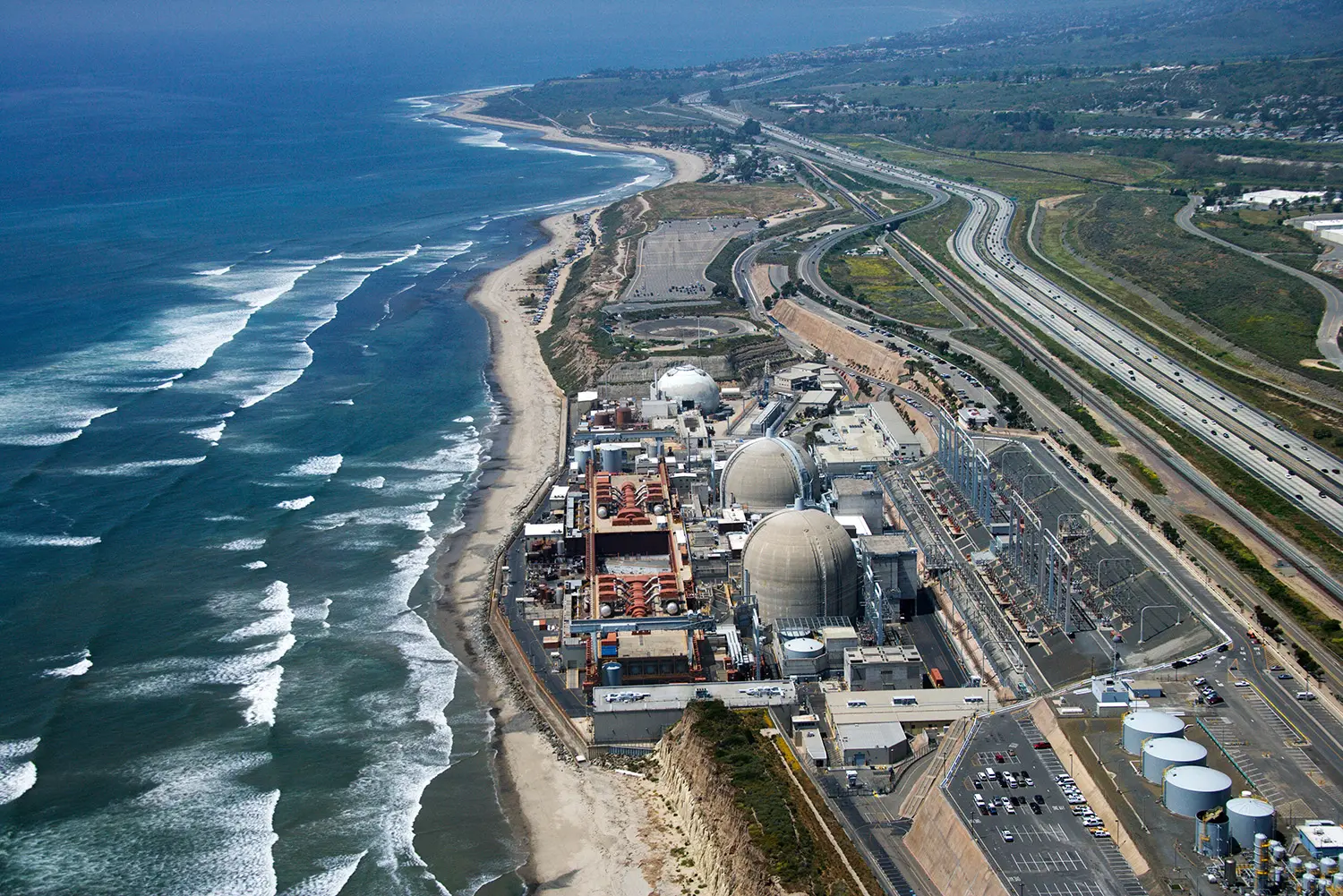
California offers a particularly visible example at the former San Onofre Nuclear Generating Station between Los Angeles and San Diego. The reactors stopped operating more than a decade ago, but the spent nuclear fuel remains.
By August 2020, Southern California Edison had transferred the remaining fuel from Units 2 and 3 into an underground dry-storage system at the site. The Nuclear Regulatory Commission currently lists 2051 as the projected completion date for activities associated with the spent-fuel storage installation, based on the anticipated removal of the fuel.
The important point is not that San Onofre’s storage system is unregulated or that disaster is inevitable. The NRC regulates these systems and considers dry storage safe when properly managed. The larger problem is that something designed as temporary storage has become necessary because the promised permanent destination never materialized.
San Onofre sits along the Southern California coast in an area where earthquakes, coastal hazards and long-term environmental changes cannot simply be ignored. Its nuclear waste must continue to be protected and monitored even though the power plant that produced it is being dismantled.
There was also a troubling reminder in 2018 that even carefully engineered systems depend on people and procedures working correctly. During a spent-fuel transfer at San Onofre, a loaded canister became caught while being lowered into its underground storage vault. Workers initially believed it had been properly inserted before unexpectedly high radiation readings helped reveal the problem. The NRC subsequently conducted a special inspection.
None of this means another Fukushima is waiting to happen in California. It does mean that radioactive waste creates responsibilities that continue long after the electricity has been consumed.
The new federal proposal could eventually move some nuclear material away from dozens of individual reactor sites, and that deserves serious study. Consolidating waste may have advantages over leaving it scattered around the country.
But moving waste is not the same thing as permanently disposing of it.
The proposed Nuclear Lifecycle Innovation Campuses would also explore reprocessing, which means recovering usable materials from spent nuclear fuel so that some of them can potentially be used again. Reprocessing can change the amount and composition of material requiring disposal, but it does not make the radioactive waste problem disappear. The NRC explains that high-level radioactive waste includes both spent reactor fuel and highly radioactive material remaining after spent fuel has been reprocessed.
The Newsweek report itself makes this uncertainty clear. Mark James, director of the Institute for Energy and the Environment at the University of Vermont, described the proposal as a reflection of the difficulty the country has had finding permanent storage. He also cautioned that reprocessing requires extremely high levels of security and that decisions involving these materials cannot put speed ahead of public health and environmental protection.
That warning becomes especially relevant when the reason for moving faster is the explosive growth of another industry.
AI data centers are real infrastructure, and they require real electricity. The question is whether every projected increase in AI demand should automatically become a justification for building enormous new power plants, transmission lines and centralized energy facilities.
The current approach often begins with a huge data center and works backward. If a company wants hundreds of megawatts of electricity at one location, the conversation quickly becomes about what giant source of electricity can supply it. Nuclear reactors, natural gas plants and major transmission projects suddenly appear necessary because the data center itself was designed around enormous, concentrated energy consumption.
There is another way to think about the problem.
Instead of asking how we can build enough giant power plants to support giant data centers, we could ask whether computing itself needs to remain so concentrated.
Researchers are already exploring what might be called distributed AI infrastructure, where computing workloads can be spread among multiple locations instead of relying entirely on enormous centralized campuses. A 2026 study on power-flexible AI data centers demonstrated that certain computing workloads can be shifted between geographically separated computing clusters in response to grid conditions. Another line of research is exploring networks of smaller, renewable-powered data centers where computing could move according to the availability of clean electricity.
This does not mean every AI workload can simply be divided among thousands of tiny computers. Large AI models sometimes require enormous numbers of processors working together with extremely fast connections, and moving huge amounts of data between locations creates technical challenges of its own. But it does mean the current hyperscale model should not automatically be treated as the only possible future.
We have already begun learning this lesson with electricity.
For most of the twentieth century, the electric grid was built around huge centralized power plants sending electricity across long transmission lines to millions of customers. Today, rooftop solar, community solar, batteries, microgrids, electric vehicles and other distributed energy resources are beginning to create a more flexible system where some electricity is produced and stored closer to where it is actually needed.
Why shouldn’t some computing infrastructure evolve in the same direction?
Smaller data centers could be located closer to existing electrical capacity and combined with rooftop solar, parking-canopy solar, batteries and other local energy resources. Computing jobs that are flexible about when or where they run could move toward locations where renewable electricity is abundant or where the grid has spare capacity. Research published in 2025 has specifically proposed distributed, grid-aware computing facilities as a way to make greater use of renewable energy while reducing some of the need for new grid construction.
There could also be a resilience benefit. Concentrating enormous amounts of computing capacity and electricity demand in a small number of giant facilities creates major points of dependency. A distributed network would not eliminate cybersecurity threats, power failures or natural disasters, but geographically spreading infrastructure can reduce the consequences of losing any single location.
That is worth considering when nuclear expansion itself is increasingly being described as a matter of national security.
AI is an extraordinary technology, and rejecting nuclear power does not require rejecting AI. It requires asking whether we are using a twenty-first century technology to justify rebuilding a twentieth-century infrastructure model.
The United States already has tens of thousands of metric tons of spent nuclear fuel without a permanent disposal facility. Communities that hosted nuclear plants decades ago are still responsible for radioactive material that was supposed to eventually go somewhere else. Now, as AI increases electricity demand, we are being told that another nuclear expansion could help supply the power.
Perhaps the better solution is not another generation of enormous centralized facilities feeding other enormous centralized facilities.
A future built around distributed renewable energy, batteries, efficiency, flexible electricity demand and more distributed computing would not eliminate every environmental problem associated with AI. Data centers would still require electricity, water, land, equipment and raw materials. But it would begin with a much healthier question: How can we design AI infrastructure to fit within a cleaner and more resilient energy system, instead of redesigning the energy system around unlimited AI growth?
Before creating another generation of nuclear waste in the name of powering the future, we should remember that we are still trying to figure out where to put the waste from the last generation.